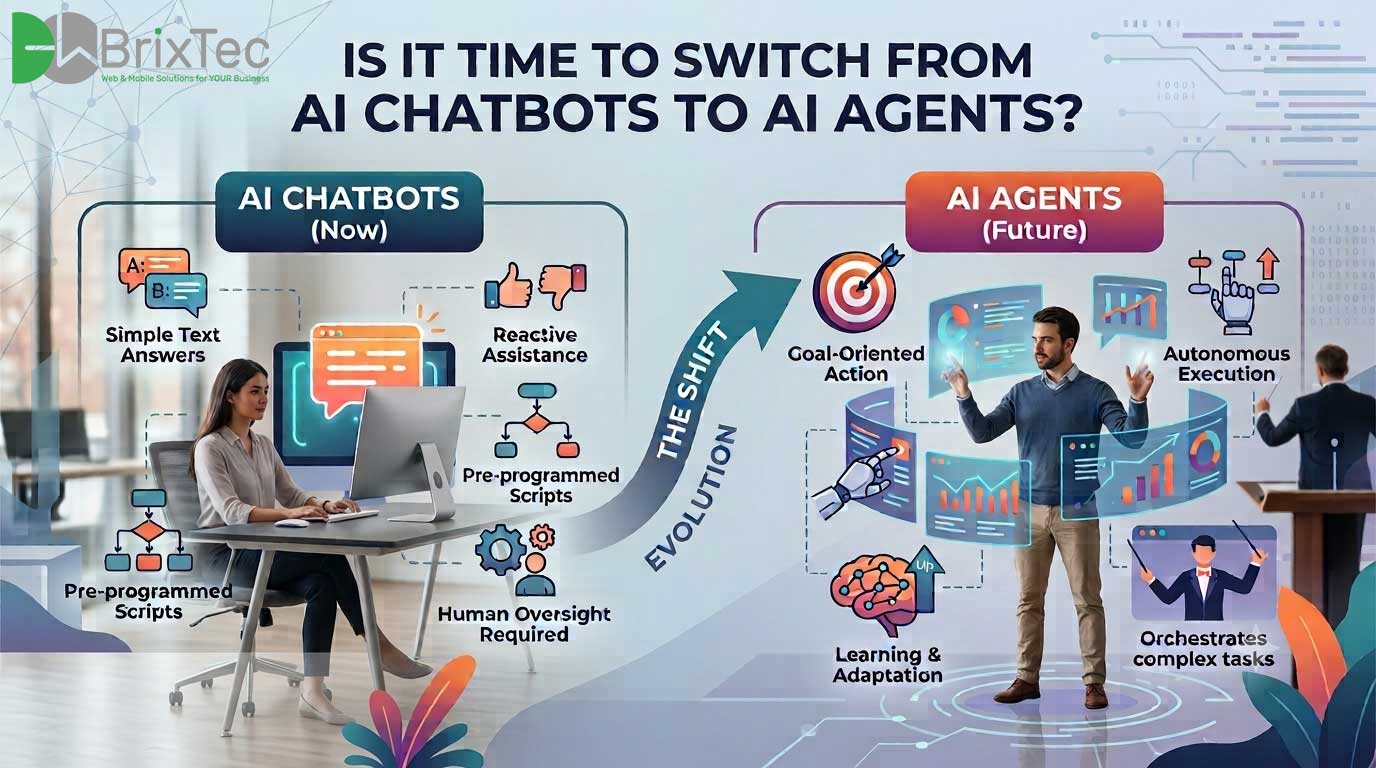
For the past few years, businesses have experimented with AI chatbots as a way to improve customer service, answer frequently asked questions, and provide faster access to information. However, artificial intelligence is entering a new phase. The conversation is shifting from AI systems that respond to AI systems that can take action. Is it time to switch from AI chatbots to agents?
As discussed in Deep View’s article, “New OpenAI data shows dramatic shift to agents”, the next evolution of artificial intelligence is not simply better conversations. It is the ability for AI systems to understand objectives, plan steps, interact with connected tools, and complete tasks with limited human involvement.
The difference between a chatbot and an AI agent is important. A chatbot generally waits for a prompt and returns an answer. An AI agent can analyze a goal, determine the necessary steps, access approved information sources, perform actions, and provide results. As AI researcher Andrew Ng and other industry leaders have noted, the future of AI is increasingly focused on systems that can perform useful tasks rather than only generate responses.
For business leaders, the question is no longer whether AI will become part of daily operations. The question is where AI agents can create measurable improvements in efficiency, customer experience, and productivity.
Which Businesses Should Consider Moving Toward AI Agents?
AI agents are especially valuable for businesses with repetitive processes, large amounts of information, customer interactions, or workflows that require multiple steps.
Companies that should evaluate AI agents include:
- E-commerce companies managing customer questions, product recommendations, order updates, returns, and sales follow-up.
- Service businesses such as contractors, agencies, and professional firms that need automated lead qualification, appointment scheduling, customer intake, and follow-up communication.
- Real estate, insurance, financial services, and legal businesses that handle large amounts of documentation and client communication.
- Companies with sales teams that spend significant time researching prospects, updating CRM systems, preparing proposals, and maintaining customer relationships.
- Organizations with administrative workloads involving scheduling, reporting, document processing, and internal knowledge management.
The opportunity is not limited to large enterprises. Small and midsize businesses may benefit significantly because AI agents can extend the capabilities of existing employees without requiring additional staff for repetitive tasks.
The Shift Is Not Only Customer-Facing
Many businesses initially think of AI agents as advanced website chatbots. While customer-facing agents are valuable, some of the earliest and most measurable benefits may come from employee-facing AI agents.
Examples include:
- Preparing proposals and business documents.
- Reviewing and summarizing information.
- Creating marketing materials.
- Researching competitors and markets.
- Organizing files and knowledge bases.
- Updating reports and spreadsheets.
- Creating internal procedures and documentation.
This is where tools such as Claude Cowork demonstrate the broader transition from chatbot to agent. Rather than simply answering questions, agent-based systems are designed around completing tasks and helping employees accomplish business objectives.
Should Businesses Completely Replace Chatbots With Agents?
For most businesses, a complete replacement is not the best approach. A hybrid strategy will likely provide the greatest value.
Traditional chatbots remain useful for simple, predictable interactions. They are effective for answering common questions, directing visitors to resources, and handling basic customer requests.
AI agents are better suited for situations requiring reasoning, multiple steps, or interaction with business systems. For example, instead of answering “Where is my order?” an AI agent could check the order system, determine shipment status, notify the customer, and create a support request if an issue exists.
The transition should be gradual. Businesses should identify processes where automation provides clear value, implement AI agents in controlled areas, measure results, and expand capabilities over time.
Security, permissions, and human oversight remain important considerations. AI agents often require access to company information and applications, so businesses should establish clear boundaries regarding what agents can access and what decisions require human approval.
AI Agent Platforms SMBs Should Explore
Small and midsize businesses do not need to build their own AI infrastructure to begin using agents. Several platforms provide practical starting points.
Claude Cowork by Anthropic is a strong option for businesses focused on knowledge work, including agencies, consulting firms, professional services companies, and internal operations teams. It is designed to help complete tasks involving documents, research, analysis, and business materials.
ChatGPT Business by OpenAI provides customizable AI assistants, data analysis capabilities, and business-oriented AI tools that can support many operational workflows.
Microsoft Copilot for Microsoft 365 is a strong choice for organizations already using Outlook, Teams, Word, Excel, and other Microsoft productivity applications.
Google Gemini for Workspace provides AI capabilities for companies using Google Workspace tools.
Zapier AI and Make are useful for businesses looking to connect existing applications and automate workflow-based processes without custom software development.
For customer-facing needs, businesses should also evaluate specialized AI customer service and sales agent platforms that integrate directly with websites, CRM systems, and support tools.
How Should SMBs Begin?
The most effective approach is to start with a business problem rather than a technology decision.
Companies should identify areas where employees spend significant time on repetitive tasks, where customers experience delays, or where information is difficult to access. Those areas are often the best candidates for AI agents.
A practical roadmap includes:
- Identify repetitive workflows that consume employee time.
- Determine whether the process requires simple automation or agent-based decision-making.
- Start with a limited pilot project.
- Measure improvements in time savings, customer satisfaction, or revenue impact.
- Expand successful implementations.
The transition from chatbots to agents represents a major change in how businesses use technology. Chatbots improved communication. AI agents have the potential to improve operations.
For many SMBs, the competitive advantage will not come from simply adopting AI. It will come from strategically applying AI agents where they can improve productivity, customer service, and business growth.